

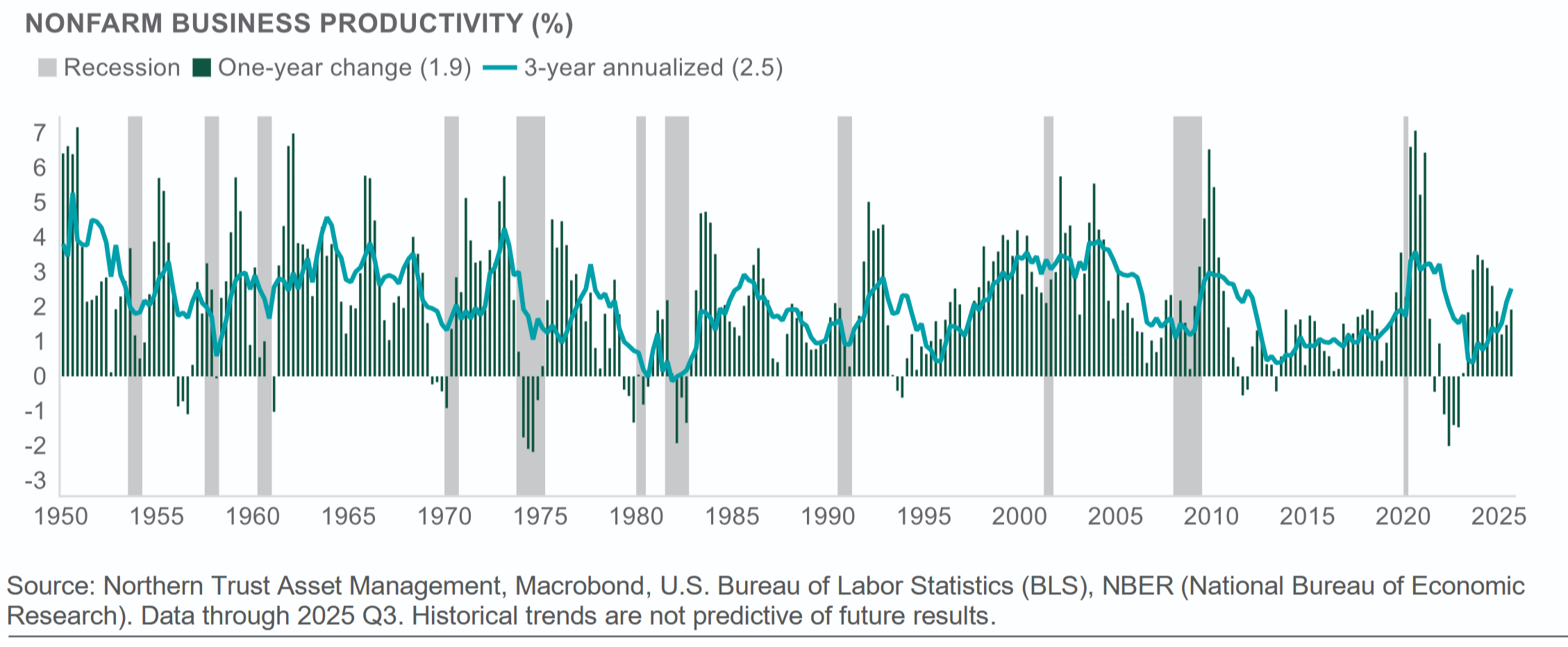
The latest U.S. productivity numbers have delivered an unexpected jolt. 3Q data revealed a large upside surprise, with output per hour rising above expectations. In theory, this should be great news: firms are doing more with less, a marker of economic vitality. Yet, the reality is more complex—and potentially troubling for the U.S. workforce.
Recent Trends. The U.S. corporate sector is achieving more with fewer hands. Even as productivity rises, hiring remains subdued. This divergence signals that businesses are squeezing greater efficiencies from existing resources, rather than expanding payrolls. With labor markets already showing signs of slack, the question arises: are we witnessing the birth of a new era of “lean growth”?
Historical Perspective: From Slow Lane to Fast Track. Since the financial crisis, U.S. productivity growth has averaged a modest 1.5% annually. Over the past five years, that figure has crept up to around 2%—a clear improvement, but one that still lags the heady days of the late 1990s. Back then, tech-driven gains propelled productivity growth to 3-4%, fundamentally reshaping the economic landscape. Today, rapid advances in AI and automation hint at a possible return to those heights. The question is whether the broader economy—and its workers—are prepared for the consequences.
Tech’s Role: A Double-Edged Sword. The tech sector remains the engine of productivity acceleration. Machine learning, robotics, and cloud computing innovations are enabling firms to amplify output with labor costs steady or even lower. If this persists, 3-4% annual productivity growth could become the new normal. But history suggests that such booms are rarely unalloyed blessings. The late 1990s saw robust job creation; today, the same forces may instead reinforce labor market bifurcation.
Labor Market Implications: The Unit Cost Conundrum.
Rising productivity, coupled with constrained wage gains, is driving down unit labor costs. This is good news for profit margins, but less so for workers whose wages lag behind. The real test will be whether these efficiency gains translate into broad-based employment growth. If not, the U.S. risks a “tepid recovery,” with profits outpacing wage growth by up to fourfold—a scenario that could exacerbate inequality and dampen consumer demand.
Key Question: Can Productivity Power Job Growth?
Productivity sets the speed limit for the economy. Sustained upside surprises are welcome, provided they are matched by robust job creation and rising incomes. If, however, the current trajectory persists—where firms grow more efficient without expanding their workforce—the U.S. may find itself in a jobless recovery, where the spoils of growth accrue disproportionately to capital over labor.
We introduced a new macro scenario to our outlook, in which tax cuts and deregulation more than offset the effects of tariffs and tighter immigration policies. In this environment, robust productivity gains persist, supporting strong economic growth without triggering higher inflation.
RISING U.S. PRODUCTIVITY
POSITIONING SCENARIOS
Fiscal and Productivity Boost (30% probability)
Tax cuts and deregulation more than offset tariff and immigration effects. Strong productivity gains continue, allowing for solid economic growth without sparking higher inflation.
Soft Landing (45% probability)
Growth slows but remains positive as the adverse effects of tariff and immigration policies are partially offset by support from lower taxes and less regulation. The rise in inflation is only temporary.
Supply Restraint (25% probability)
Supply-side shocks from higher tariffs in addition to broader policy uncertainty weigh on consumer and corporate activity while halting the disinflationary process until a mild recession takes shape.
Note: Probabilities are assumed from proprietary research and are subject to change.
IMPORTANT INFORMATION. This material is provided for informational purposes only. Current or prospective clients should under no circumstances rely upon this information as a substitute for obtaining specific legal or tax advice from their own professional legal or tax advisors. All material has been obtained from sources believed to be reliable, including Northern Trust Asset Management, Dimensional Fund Advisors, J.P. Morgan Asset Management, Blackrock, and Vanguard, but the accuracy, completeness and interpretation cannot be guaranteed. Information contained herein is current as of the date appearing in this material only and is subject to change without notice. Past performance is no guarantee of future results. Forward looking statements and assumptions are Investment Trust Company's current estimates or expectations of future events based upon research and should not be construed as an estimate or promise of results that a portfolio may achieve. Actual results and account activities could differ materially from the results indicated by this information.
For more information please contact:
Steven E. Post, CFP®
Senior Vice President
Director of Portfolio Management
Denver: 303.778.6800
Colorado Springs: 719.632.4677